




Refer to PSP 28th Perihelion Campaign page.
2026-06-07 (CSV, PDF table of coordinates)
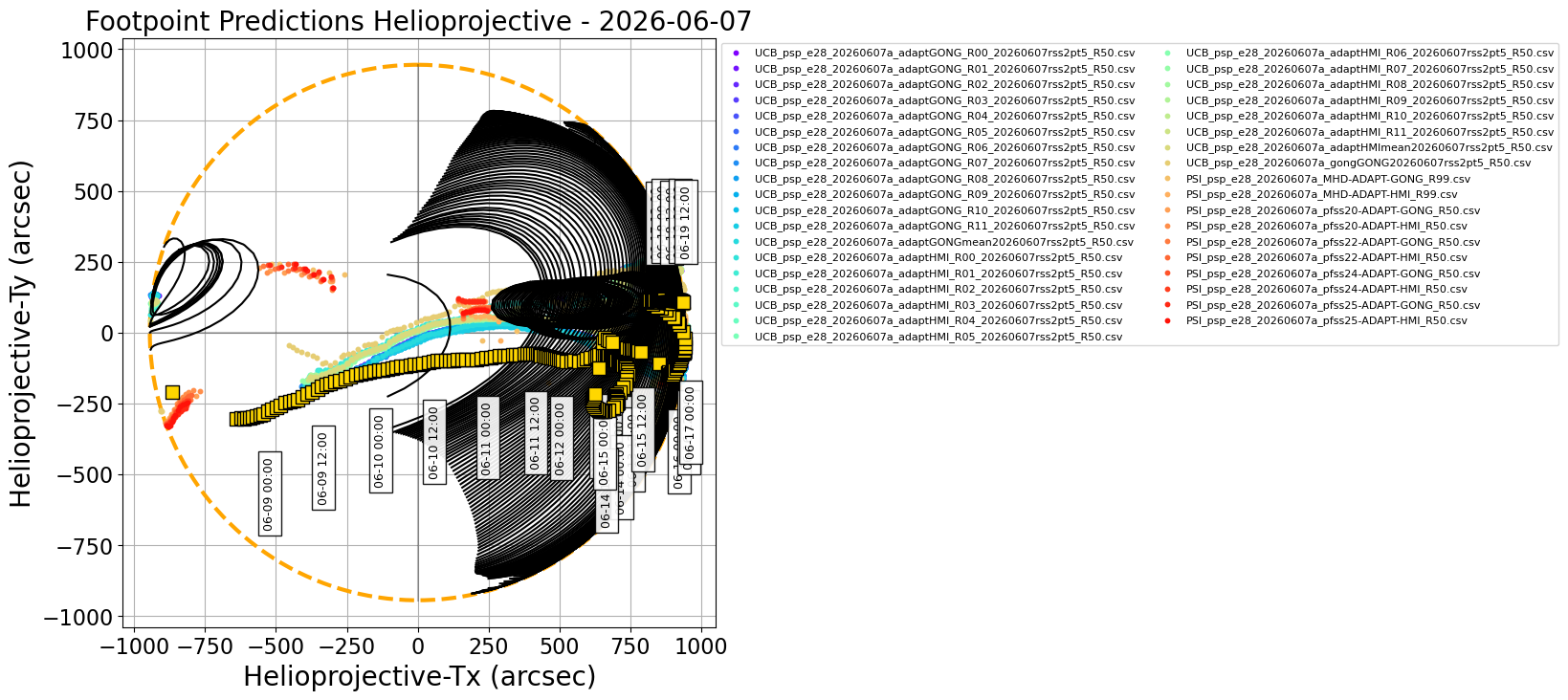
Figure 1.
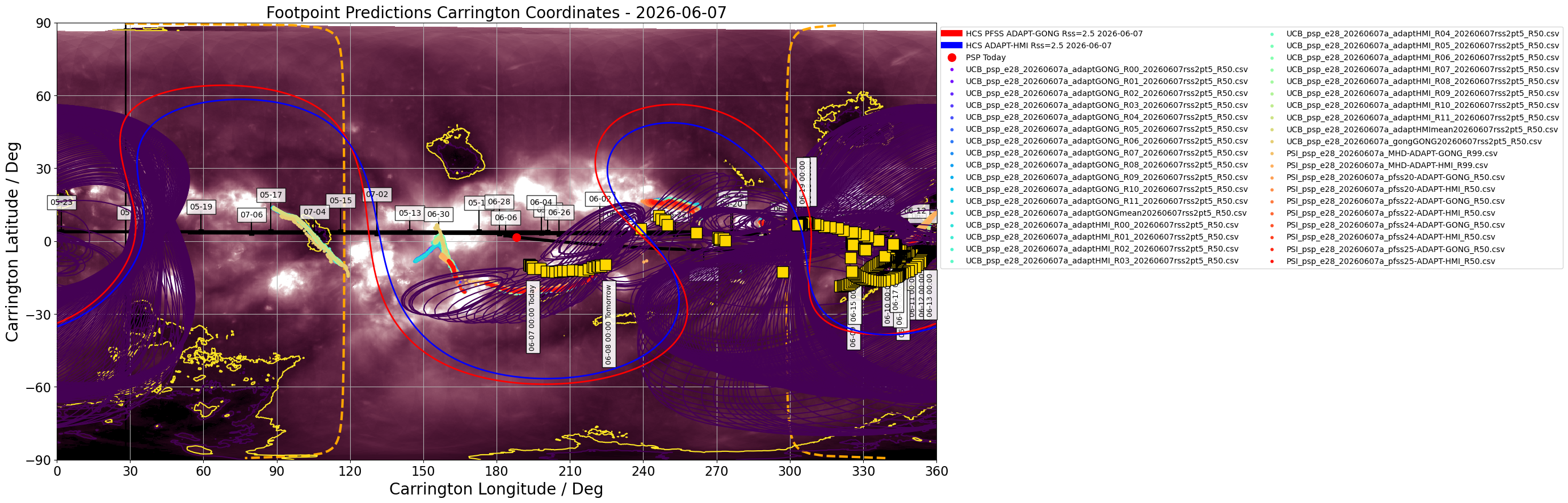
Figure 2.
Figures above show one footpoint per day plotted on the solar disk and in Carrington coordinates (click on figure to zoom and see caption).
The predicted footpoints were kindly provided by the PSP 24rd Perihelion modeling team.
Encounter 28 Prediction update 1/5: 2026/06/07
------------------------------------------------
This is the first of five daily footpoint predictions issued today through Thursday June 11 for Parker Solar Probe Encounter 28, Parker's 7th perihelion at 9.86Rs. Perihelion 28 occurs tomorrow, Monday 2026/06/08 at 04:35 UT (00:35 EDT). For its inbound orbital phase, Parker has been on the solar far side and is today moving rapidly towards Earth over the solar East limb. By tomorrow, 6/8, the spacecraft should be connected to solar wind sources on the visible solar disk and over the coming days will progress rapidly across sources towards the central meridian.
Magnetic Connectivity
---------------------
Connectivity will first reach the visible disk over the east limb tomorrow, 2026/6/8 around 1500 UT (shortly after perihelion) and will progress rapidly to disk center. Initially it will stick to a small coronal hole at moderately negative latitudes on the East limb for about 12 hours. A current sheet crossing to negative polarity is then predicted with connection to a coronal hole in the southern latitude bands. The connection will then remain in negative polarity and will advance across the disk over various mid-latitude sources in the active region band. By the end of this encounter's predictions on 6/11, the footpoints will have just passed the central meridian, but will remain on disk throughout the outbound cruise phase of the current orbit.
There is an overall larger than normal spread in the ensemble in today's predictions which will be investigated before tomorrow's update which will include more model inputs.
Flare Likelihood (CCMC Flare Scoreboard)
----------------------------------------
As of the 2026/06/07 ISWA CCMC Flare Scoreboard reports full-disk 24-hour average flare probabilities are 15% for M-class and above and 0% for X-class flares. (SIDC reports the probability of an M-class flare >50%). The strongest flare reported over the past 24 hours was a GOES M1.8 flare peaking at 2026/06/06 14:01 UT from NOAA AR 14461 in the southeast quadrant. NOAA active regions visible on the disk include ARs 14454, 14455, 14456, 14458, 14459, 14461, 14462, 14463, and 14464. SIDC reports eight numbered regions on the disk, with AR 14456 the most complex region, now classified as beta-gamma-delta. AR 14461 remained a simpler beta region despite producing the M1.8 flare.
From the CCMC CME Scoreboard, the 2026/06/06 14:11 UT CME is predicted to have an Earth-directed component. The event is listed as a southeast partial-halo CME associated with the eruption and M1.8 flare from AR 14461.
------------------
*** Please note that the "arrival time" and "emission time" and associated Tx/Ty coordinates for both are reported in the consensus CSV file. The attached plots show the "arrival time" (location of source at time that plasma will arrive at PSP). See this doc for some discussion on these***.
2026-06-08 (CSV, PDF table of coordinates)
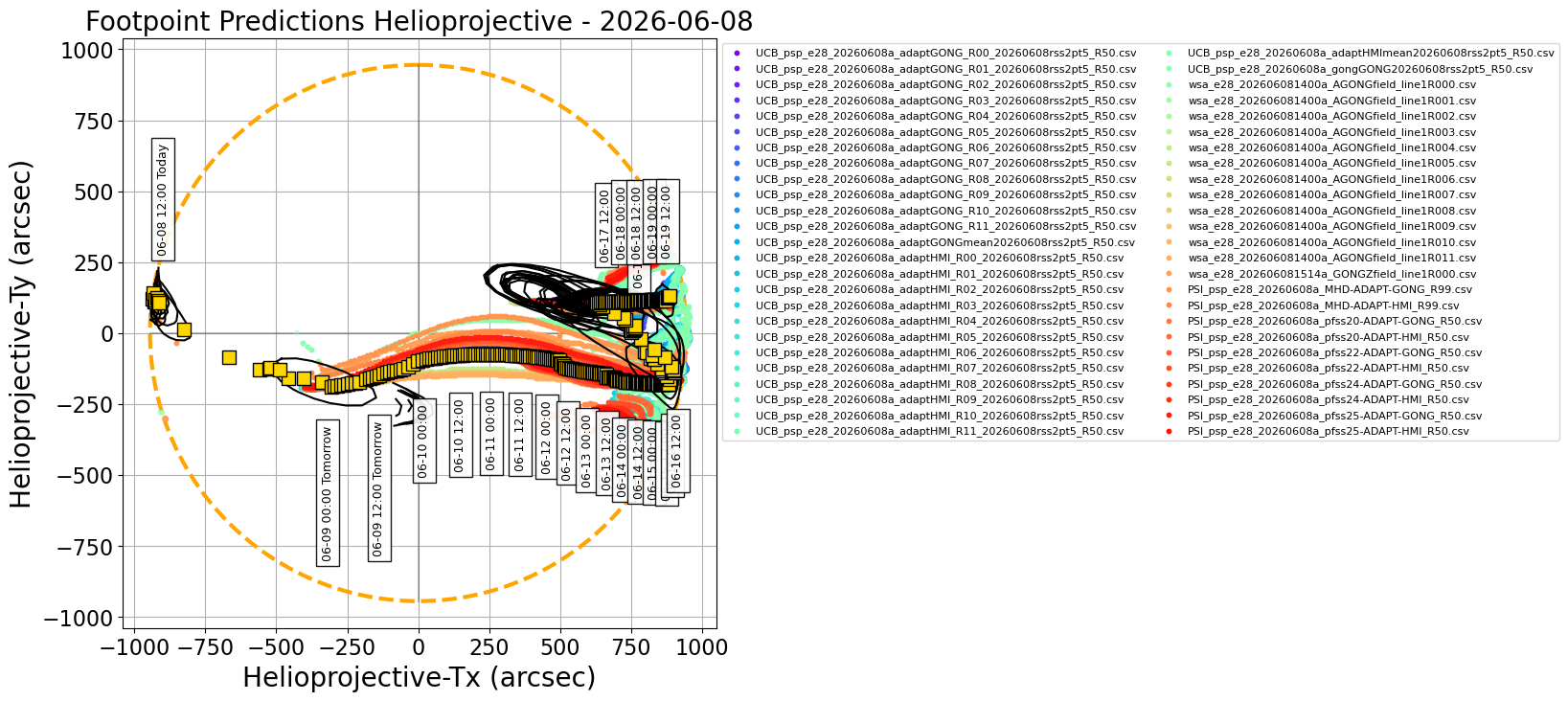
Figure 1.
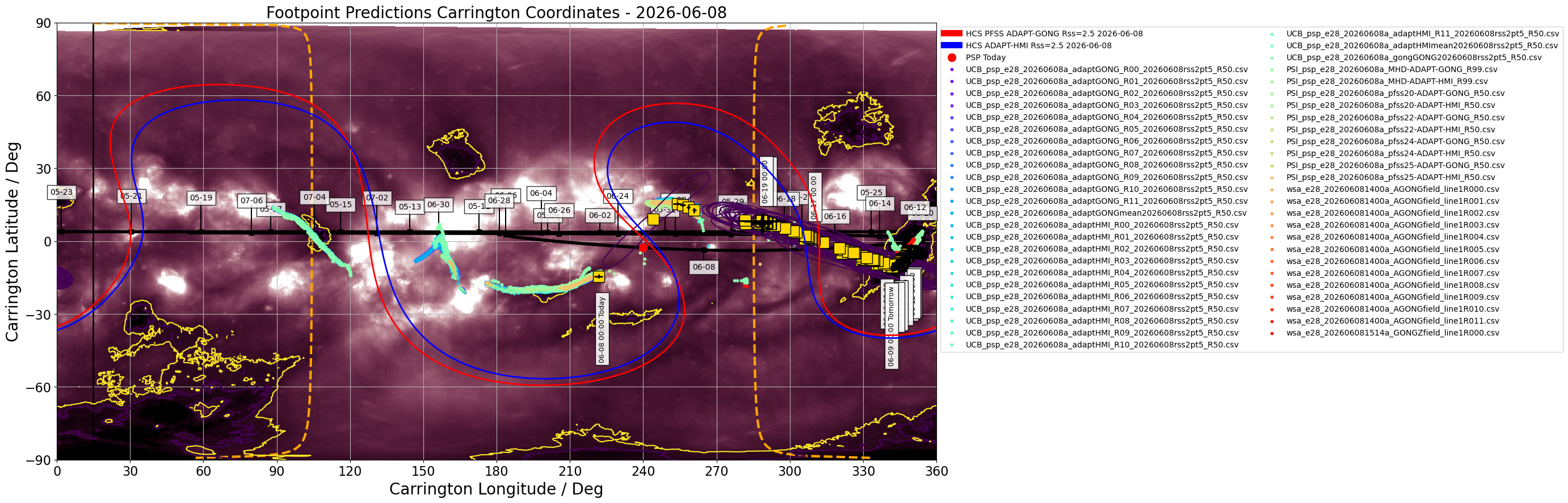
Figure 2.
Figures above show one footpoint per day plotted on the solar disk and in Carrington coordinates (click on figure to zoom and see caption).
The predicted footpoints were kindly provided by the PSP 24rd Perihelion modeling team.
Encounter 28 Prediction update 2/5: 2026/06/08
------------------------------------------------
This is the second of five daily footpoint predictions issued today through Thursday June 11 for Parker Solar Probe Encounter 28, Parker's 7th perihelion at 9.86Rs. Perihelion 28 occurred today, Monday 2026/06/08 at 04:35 UT (00:35 EDT). For its inbound orbital phase, Parker has been on the solar far side. As of today, the spacecraft is connected to solar wind sources on the visible solar disk and over the coming days will progress rapidly across sources towards the central meridian.
Magnetic Connectivity
---------------------
Footpoints predictions today change a small amount with respect to yesterday due to some uncaught errors with some ensemble members. Broadly speaking, the footpoints still remain embedded in the latitude active region belts but the precise timing in which they jump from source to source has changed by a few hours. We expect the predictions to remain stable the rest of the encounter.
Footpoints are expected to have come on disk around 06:00 UTC today. Having first connected to near equatorial latitudes this morning, they are predicted to cross the heliospheric current sheet around 23:00 UTC and jump to the south-eastern boundary of a negative polarity, transequatorial coronal hole, which is the most prominent equatorial hole visible on disk right now (see: SolarMonitor.org).
Predictions beyond this point are remarkably stable: They remain embedded in this coronal hole and track from its Eastern edge into the center (still at southern latitudes), and simply remain there as the coronal hole co-rotates through at least 2026/06/16. The angular speed of Parker will have decreased sufficiently at this point for the footpoints to be outrstripped by the coronal holes continued rotation off the limb, and will trace back through the Eastern edge onto other on-disk sources.
Flare Likelihood (CCMC Flare Scoreboard)
----------------------------------------
As of 2026/06/08 at 12:00 UT ISWA CCMC Flare Scoreboard reported 24-hour average cumulative probabilities amounting to 99%, 55% and 3% for GOES C and above, M and above and X-class flares, respectively. These appear to be elevated compared to yesterday’s update. The strongest flare reported over the past 24 hours was a GOES C7.2 flare peaking at 2026/06/08 02:36 UT, apparently stemming from NOAA AR 14465 close to the east limb. NOAA active regions visible on the disk include ARs 14455, 14456, 14458, 14459 and 14461 - 14465. These are mostly located in the northern hemisphere from eastern to western longitudes with only NOAA ARs 14458, 14461 and 14464 in the south. The corona shows a relatively small, transequatorial coronal hole located just east of the central meridian, which is the major on disk source Parker is predicted to connect to this encounter.
From the CCMC CME Scoreboard, the 2026/06/06 14:11 UT CME is predicted to have an Earth-directed component. The estimated near-Sun speed was high, at 1396 km/s, and was associated with the GOES M1.8 flare reported yesterday from NOAA AR 14461. Expected shock arrival time varies from am to pm hours today, with the geomagnetic event expected to be mostly between moderate (Kp=6) and severe (Kp=8). A second Earth-directed CME with a near-Sun speed of 270 km/s was apparently launched from the vicinity of NOAA AR 14464 a few hours ago (2026/06/08 at 06:12 UT). Predicted arrival time is 2026/06/11 at 20:00 UT. The encounter is not expected to trigger a stronger than minor geomagnetic event (Kp ≤ 5).
------------------
*** Please note that the "arrival time" and "emission time" and associated Tx/Ty coordinates for both are reported in the consensus CSV file. The attached plots show the "arrival time" (location of source at time that plasma will arrive at PSP). See slide deck for some discussion on these***.
2026-06-09 (CSV, PDF table of coordinates)
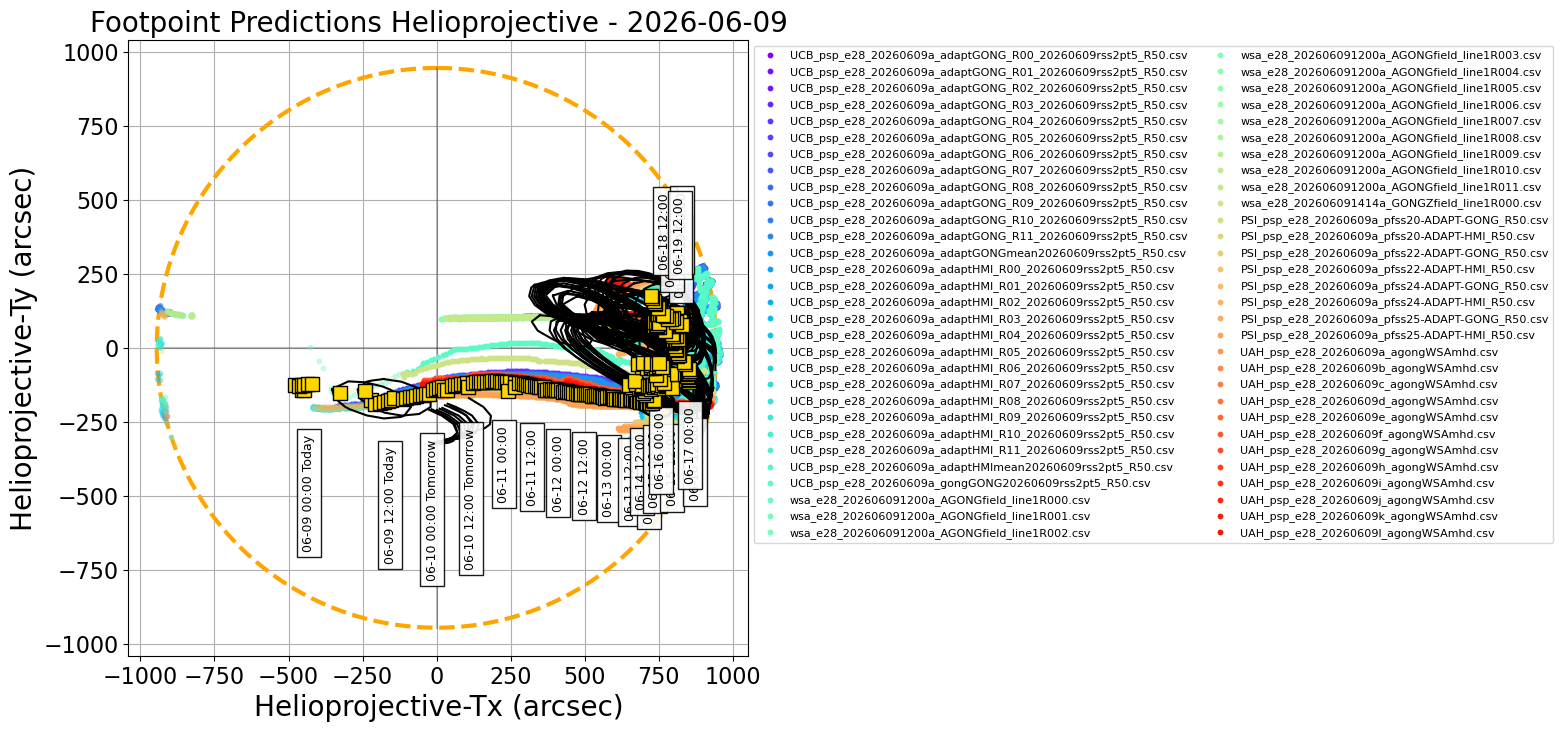
Figure 1.
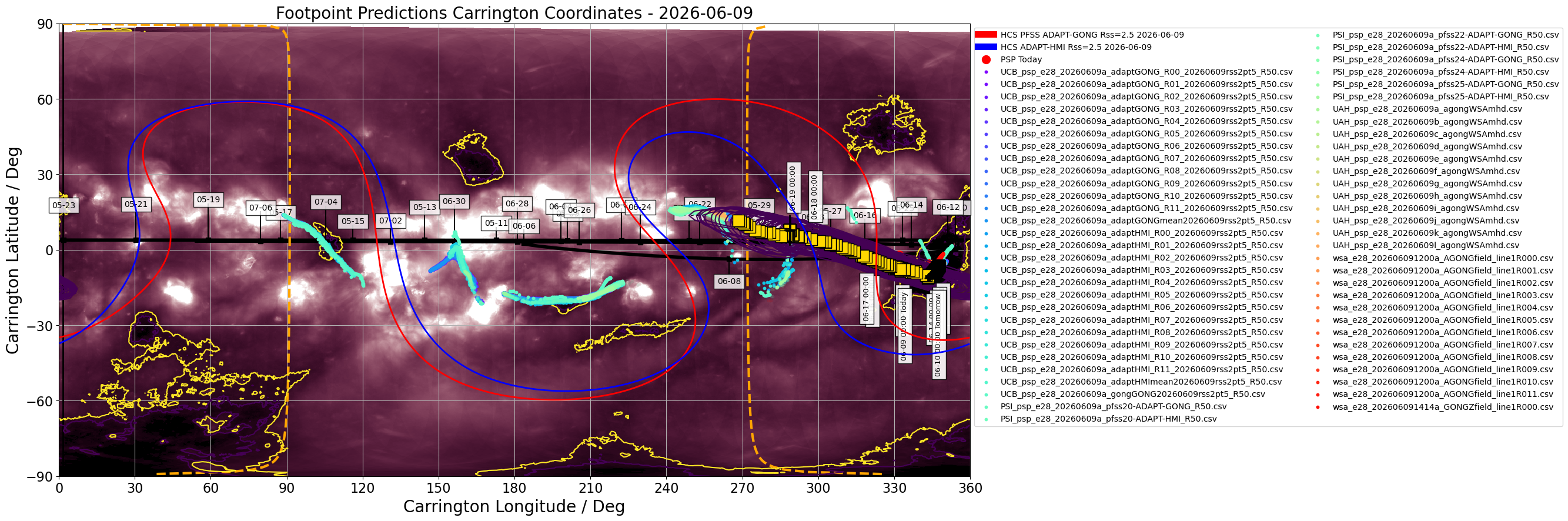
Figure 2.
Figures above show one footpoint per day plotted on the solar disk and in Carrington coordinates (click on figure to zoom and see caption).
The predicted footpoints were kindly provided by the PSP 24rd Perihelion modeling team.
Encounter 28 Prediction update 3/5: 2026/06/09
------------------------------------------------
This is the third of five daily footpoint predictions issued today through Thursday June 11 for Parker Solar Probe Encounter 28, Parker's 7th perihelion at 9.86Rs. Perihelion 28 occurred yesterday, Monday 2026/06/08 at 04:35 UT (00:35 EDT). For its inbound orbital phase, Parker was on the solar far side. As of today, the spacecraft is connected stably to a transequatorial coronal hole near the central meridian and is predicted to remain in that coronal hole's stream through the outbound phase of the orbit.
Magnetic Connectivity
---------------------
Footpoint predictions remain stable from yesterday, connecting to the south-eastern boundary of a negative polarity, transequatorial coronal hole, which is the most prominent equatorial hole visible on disk right now, lying right on the central meridian (SolarMonitor.org).
Beyond today, footpoints remain embedded in this coronal hole and track from its Eastern edge into the center (still at southern latitudes), and simply remain there as the coronal hole co-rotates through at least 2026/06/14. The angular speed of Parker will have decreased sufficiently at this point for the footpoints to be outrstripped by the coronal hole's continued rotation off the limb, and will trace back through the Eastern edge onto other on-disk sources.
Flare Likelihood (CCMC Flare Scoreboard)
----------------------------------------
As of 2026/06/08 at 12:00 UT ISWA CCMC Flare Scoreboard reported 24-hour average cumulative probabilities amounting to 99%, 24% and 3% for GOES C and above, M and above and X-class flares, respectively. These are similar to yesterday’s update. The strongest flare reported over the past 24 hours was a C4.5 flare stemming from NOAA AR 14465 which is still at far eastern longitudes. NOAA active regions visible on the disk include ARs 14456, 14458, 14459 and 14461 - 14465. These are mostly located in the northern hemisphere from eastern to western longitudes with only NOAA ARs 14458, 14461 and 14464 in the south. The relatively small transequatorial coronal hole reported yesterday is now aligned with the central meridian. As reported yesterday, this is the major on-disk source Parker is predicted to connect to this encounter.
From the CCMC CME Scoreboard, an Earth-directed CME with a near-Sun speed of 270 km/s was launched from the vicinity of NOAA AR 14464 on 2026/06/11 at 20:00 UT. The encounter is not expected to trigger a stronger than minor geomagnetic event (Kp ≤ 5).
------------------
*** Please note that the "arrival time" and "emission time" and associated Tx/Ty coordinates for both are reported in the consensus CSV file. The attached plots show the "arrival time" (location of source at time that plasma will arrive at PSP). See slide deck for some discussion on these***.
2026-06-10 (CSV, PDF table of coordinates)
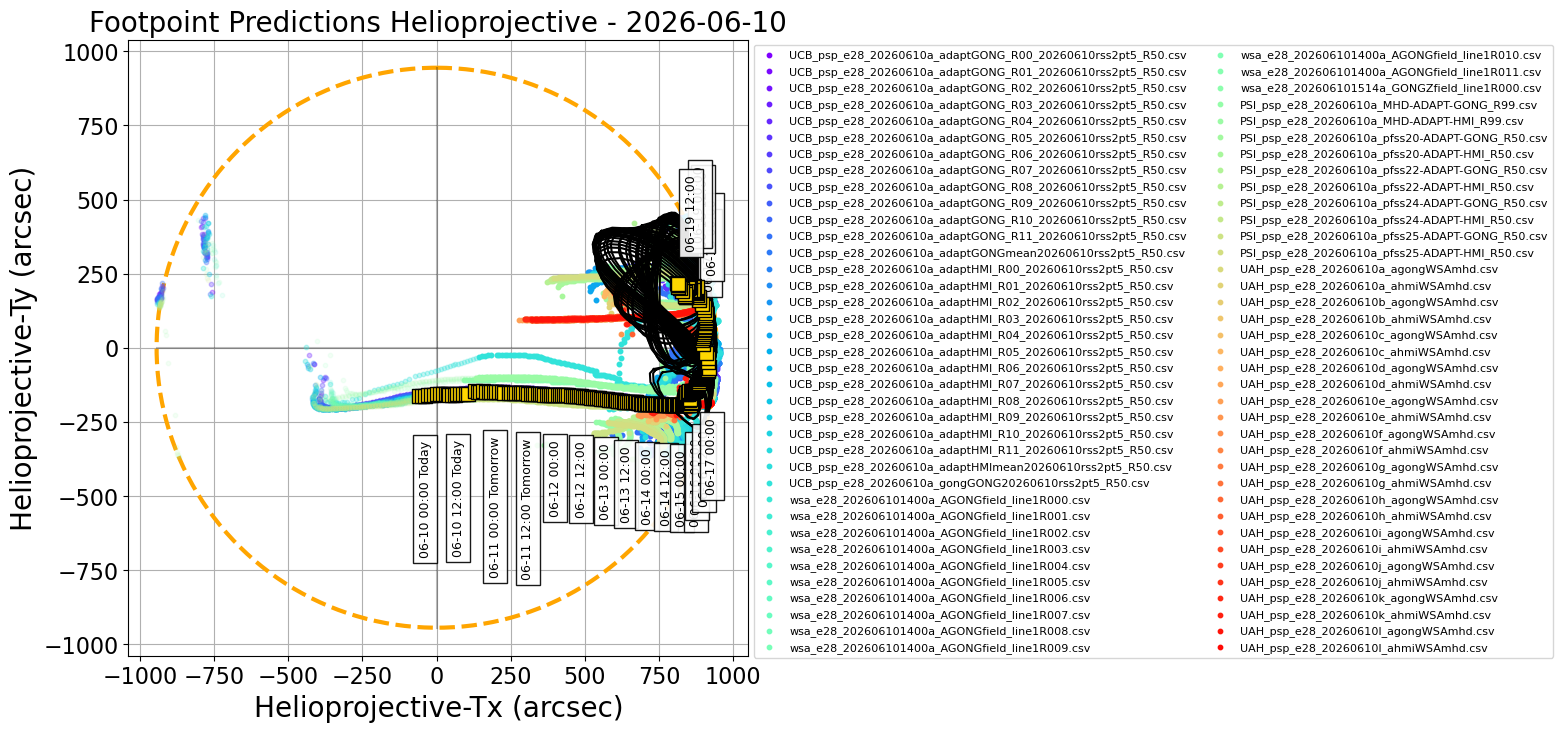
Figure 1.
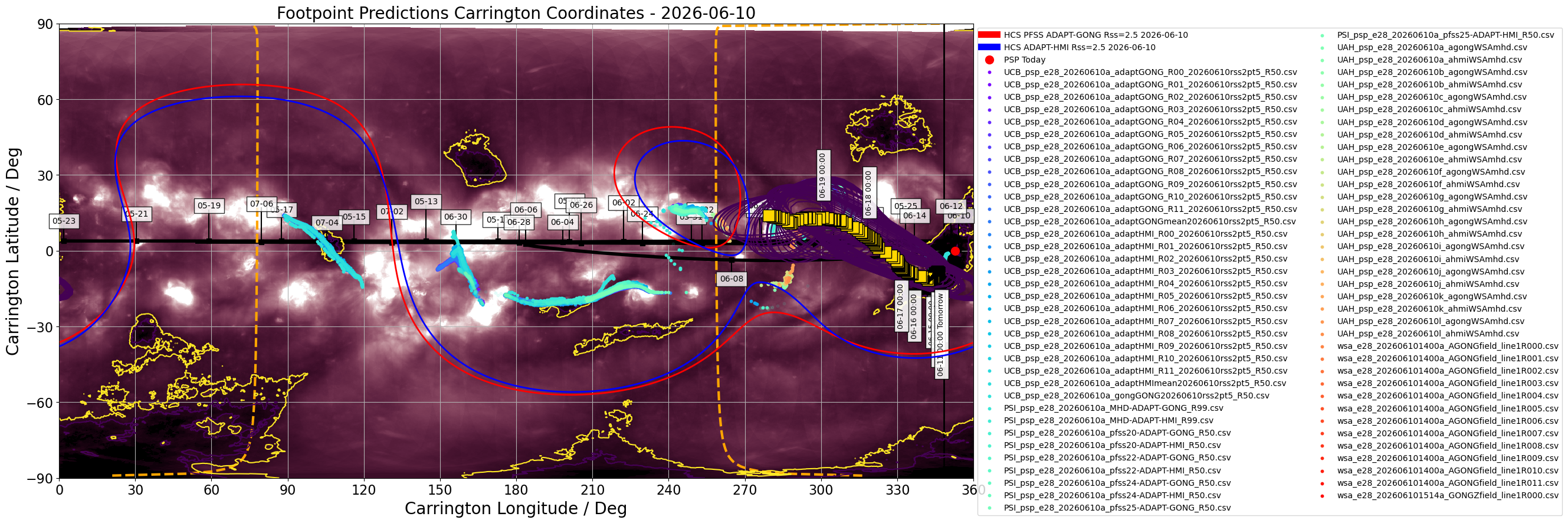
Figure 2.
Figures above show one footpoint per day plotted on the solar disk and in Carrington coordinates (click on figure to zoom and see caption).
The predicted footpoints were kindly provided by the PSP 24rd Perihelion modeling team.
Encounter 28 Prediction update 4/5: 2026/06/10
------------------------------------------------
This is the fourth of five daily footpoint predictions issued today through Thursday June 11 for Parker Solar Probe Encounter 28, Parker's 7th perihelion at 9.86Rs. Perihelion 28 occurred on Monday 2026/06/08 at 04:35 UT (00:35 EDT). For its inbound orbital phase, Parker was on the solar far side. Today, the spacecraft continues to be connected stably to a transequatorial coronal hole near the central meridian and is predicted to remain in that coronal hole's stream through the outbound phase of the orbit.
Magnetic Connectivity
---------------------
Footpoint predictions remain stable from the last two days, connecting to the southern latitude interior of a negative polarity, transequatorial coronal hole, which is the most prominent equatorial hole visible on disk right now, lying just westwards of the central meridian (SolarMonitor.org).
Beyond today, footpoints remain embedded deep in this coronal hole and track with it across the solar disk until at least 2026/06/15. The angular speed of Parker will have decreased sufficiently at this point for the footpoints to be outstripped by the coronal hole's continued rotation off the limb, and will trace back through the Eastern edge onto other on-disk sources.
One further note: Today's magnetograms are now starting to reflect the updated magnetic configuration under which Parker's perihelion occurred on Monday and suggest greater uncertainty about whether the sources will be positive or negative polarity, and whether current sheet crossings before and after perihelion will be observed in in situ data.
Flare Likelihood (CCMC Flare Scoreboard)
----------------------------------------
As of 2026/06/10 at 12:00 UT, the ISWA CCMC Flare Scoreboard reported 24-hour average cumulative probabilities of 99%, 40%, and 5% for GOES C and above, M and above and X-class flares, respectively. These are slightly elevated compared to yesterday's update. The strongest flare reported over the past 24 hours was a GOES C1.8 event stemming from NOAA AR 14466. NOAA active regions visible on the disk include ARs 14456, 14459, and 14461 - 14466. All except NOAA ARs 14461 and 14464 are located in the northern hemisphere. The small transequatorial coronal hole to which Parker is magnetically connected since shortly after perihelion has rotated to western longitudes.
From the CCMC CME Scoreboard, there are apparently three Earth-directed CMEs: (1) the one already reported, with a near-Sun speed of 270 km/s launched on 2026/06/08 at 06:12 UT; (2) one launched on 2026/06/09 at 16:36 UT from the vicinity of NOAA AR 14463 with a near-Sun speed of 380 km/s; and (3) one launched on 2026/06/09 at 21:36 UT from the vicinity of NOAA AR 14461 with a near-Sun speed of 348 km/s. While the first is expected to reach geospace around 2026/06/11 at 20:00 UT with up to a minor geomagnetic event expected, the other two CMEs are expected to both arrive early on 2026/06/13, at 01:00 - 02:00 UT. Each of them is separately expected to give rise to no more than a minor geomagnetic event (Kp ≤ 5), but a potential superposition of both events may lead to nonlinear effects and possibly a stronger geoeffectiveness. Further, the Earth-directed trajectory means they are likely to influence Parker's in situ measurements.
------------------
*** Please note that the "arrival time" and "emission time" and associated Tx/Ty coordinates for both are reported in the consensus CSV file. The attached plots show the "arrival time" (location of source at time that plasma will arrive at PSP). See slide deck for some discussion on these***.
2026-06-11 (CSV, PDF table of coordinates)

Figure 1.

Figure 2.
Figures above show one footpoint per day plotted on the solar disk and in Carrington coordinates (click on figure to zoom and see caption).
The predicted footpoints were kindly provided by the PSP 24rd Perihelion modeling team.
Encounter 28 Prediction update 5/5: 2026/06/11
------------------------------------------------
This is the last of five daily footpoint predictions issued for Parker Solar Probe Encounter 28, Parker's 7th perihelion at 9.86Rs. Perihelion 28 occurred on Monday 2026/06/08 at 04:35 UT (00:35 EDT). For its inbound orbital phase, Parker was on the solar far side. Today the spacecraft continues to be connected stably to a transequatorial coronal hole now westwards of the central meridian and is predicted to remain in that coronal hole's stream through the outbound phase of the orbit.
Magnetic Connectivity
---------------------
Footpoint predictions remain stable connecting to the southern latitude interior of a negative polarity, transequatorial coronal hole, which is the most prominent equatorial hole visible on disk right now, lying just westwards of the central meridian (SolarMonitor.org.
Beyond today, footpoints remain embedded deep in this coronal hole and track with it across the solar disk until at least 2026/06/15, and potentially all the way until 2026/06/17 (just after the coronal hole passes over the western limb). The angular speed of Parker will then have decreased sufficiently at this point for the footpoints to be outstripped by the coronal hole's continued rotation, and will trace back through the Eastern edge onto other near East limb sources.
Further note: After appearing to become less coherent in yesterday's magnetograms, the structure of the HCS around perihelion has reverted back to its prior state and in this last update we predict Parker should pass through two current sheets just before and after perihelion, with positive polarity during closest approach.
Flare Likelihood (CCMC Flare Scoreboard)
----------------------------------------
As of 2026/06/11 at 12:00 UT, the ISWA CCMC Flare Scoreboard reported 24-hour average cumulative probabilities of 95%, 35%, and 3% for GOES C and above, M and above and X-class flares, respectively. These are slightly lower than in yesterday’s update. The strongest flare reported over the past 24 hours was a GOES C9.0 event peaking at 08:22 UT on 2026/06/11 and stemming from NOAA AR 14465. NOAA active regions visible on the disk include ARs 14459 and 14461 - 14466. All except NOAA ARs 14461 and 14464 are located in the northern hemisphere. The small transequatorial coronal hole to which Parker is magnetically connected since shortly after perihelion has rotated further to western longitudes.
From the CCMC CME Scoreboard, there are apparently four Earth-directed CMEs: (1) one with a near-Sun speed of 270 km/s launched on 2026/06/08 at 06:12 UT from the vicinity of NOAA AR 14464; (2) one launched on 2026/06/09 at 16:36 UT from the vicinity of NOAA AR 14463 with a near-Sun speed of 380 km/s; (3) one launched on 2026/06/09 at 21:36 UT from the vicinity of NOAA AR 14461 with a near-Sun speed of 348 km/s; and (4) one launched on 2026/06/11 at 00:36 UT from the vicinity of NOAA AR 14465 with a mean near-Sun speed of approx. 890 km/s. While the first is expected to reach geospace around 2026/06/11 at 20:00 UT with up to a minor geomagnetic event expected, the other two CMEs are expected to both arrive early on 2026/06/13, at 01:00 - 02:00 UT. Each of them is separately expected to give rise to no more than a minor geomagnetic event (Kp ≤ 5), but a potential superposition of both events may lead to nonlinear effects and possibly a stronger geoeffectiveness. The most recent CME event is expected to reach geospace on 2026/06/13 with time of arrival spanning between approx. 09:10 UT and approx. 16:13 UT, depending on the forecast model. This CME could trigger up to a strong geomagnetic event (Kp ≤ 5). Events 2 - 4 are likely to influence Parker’s in situ measurements given their propagation toward Earth.
------------------
*** Please note that the "arrival time" and "emission time" and associated Tx/Ty coordinates for both are reported in the consensus CSV file. The attached plots show the "arrival time" (location of source at time that plasma will arrive at PSP). See slide deck for some discussion on these***.
Date and arrival time of plasma parcel at PSP, consensus carrington longitude (deg), latitude (deg), error in longitude, error in latitude, on-disk position of predicted source in X and Y (arcseconds) at arrival time, date and emission time of plasma parcel at the source, on-disk position of predicted source at time parcel is emitted. Each row is the updated source location each hour.
The consensus is generated by forming a distribution of footpoint predictions from all modelers for each hour period, and attempting to fit a Kent distribution. If the fitting fails, the median in longitude and latitude are quoted. If the fitting is successful, the quoted errors are formed by drawing random samples from the fitted distribution and computing the standard deviation in longitude and latitude of those samples. If the fitting fails, the quoted errors are the standard deviation in the longitude and latitude from the raw distribution of predictions. The full shape of the distribution is described by black contours in the associated plots on this website. More details about the procedure can be found at the following preprint of Badman et al. (2023) "Prediction and Verification of Parker Solar Probe Solar Wind Sources at 13.3Rs"
Please note the carrington coordinates (lon,lat) are valid from the quoted timestamp (in UTC) until the next timestamp. The helioprojective coordinates quoted (HP-Tx, HP-Ty) are computed from the carrington coordinate at the quoted timestamp (e.g. midnight UTC each day) and so are valid instantaneously at this time but will corotate with the Sun until the next quoted timestamp. For a discussion of the subtle difference in emission and arrival time and why both are included please see the slide deck.
Individual model prediction tables of coordinates may be found in a Public DropBox. Files in the Public DropBox have three-letter identifiers indicating the associated model (see below).
Three-letter designation for Public DropBox: UCB. Kindly provided by Sam Badman. The model is a simple ballistic propagation from PSP down to the source surface assuming slow wind 360km/s, and then tracing this sub-PSP trajectory through a PFSS model to get footpoints at the photosphere. The source surface height here is 2.5Rs. The PFSS model is generated using various ADAPT maps with GONG and HMI as input, and the model is run using the open source pfsspy package. A more detailed explanation of the model and comparison to PSP E1 results are given here.
Three-letter designation for Public DropBox: PSI. Kindly provided by Pete Riley. For these predictions, PSI is using a combination of modeling approaches, including PFSS solutions, empirically-based polytropic MHD solutions, and a more sophisticated approach that includes the effects of waves and turbulence to heat the corona and the WKB approximation for wave pressures to accelerate the solar wind. Additionally, boundary conditions are derived from both HMI and ADAPT synoptic magnetograms. Together, these allow us to generate a rich set of ensemble realizations from which to make our optimal prediction, as well as pool them with other teams’ forecasts to derive a hyper-ensemble prediction.
Three-letter designation for Public DropBox: wsa. Kindly provided by Shaela Jones. The Wang-Sheeley-Arge (WSA) model is a combined empirical and physics-based model of the corona and solar wind. The coronal portion of the Wang-Sheeley-Arge (WSA) model is comprised of the Potential Field Source Surface (PFSS) and Schatten Current Sheet (SCS) models, where the output of the PFSS model serves as input to the SCS model. The solar wind portion of WSA consists of a simple 1-D kinematic propagation code that takes stream interactions into account in an ad-hoc fashion. It provides predictions of the solar wind speed and interplanetary magnetic field IMF polarity at any specified point in the inner heliosphere. The WSA model can use global maps of the photospheric magnetic flux measurements from a number of sources as its inner boundary condition; here we are using an ensemble of maps from the Air Force Data Assimilative Photospheric Flux Transport (ADAPT) model, based on input GONG magnetograms.
UAH predictions come from the University of Alabama, Huntsville Multiscale Fluid-Kinetic Simulation Suite (MS-FLUKSS, Pogorelov et al. (2014); Pogorelov (2023); Singh et al. (2022)), which can solve the Reynolds-averaged ideal MHD equations for the mixture of thermal and nonthermal solar wind ions coupled with the kinetic Boltzmann equation describing the transport of neutral atoms. An adaptive mesh refinement technique can be employed for efficient high-resolution calculations. The MS-FLUKSS heliospheric MHD model is coupled with the WSA model (Kim et al., 2020), which uses both ADAPT-GONG and ADAPT-HMI input magnetograms, with the PFSS source surface height and the WSA outer boundary at 2.5 and 10 solar radii, respectively. Hence, field line tracing is performed through the MHD domain down to 10 solar radii instantaneously at approximately 1 hour cadence, where the origin of the field line on the photosphere is already known, as described for WSA.
see Prediction and Verification of Parker Solar Probe Solar Wind Sources at 13.3Rs, Badman et al. (2023)
